Raiden Zero
Legende
Also DR allgemein bringt einen extremen Sprung in SuperPi. Also zumindest auf jeder Plattform, auf der ich’s bisher am laufen hatte. Auf Sockel A hab ich’s noch nicht getestet.
Follow along with the video below to see how to install our site as a web app on your home screen.

Anmerkung: this_feature_currently_requires_accessing_site_using_safari


 the system booted! I left it running for 1hour, burnning at 3.3vdimm


Jain. Athlon XP ist an der Stelle speziell. Eigentlich sollte jede Plattform von DR Modulen profitieren, weil Bank Interleaving besser rennt. Aber am Athlon XP verlierst du durch den Ramcontroller vom NF2 an Takt, wenn du von SR auf DR gehst. Zusätzlich benchen wir FSB/Ram immer synchron, sprich der Taktverlust am Ram sorgt auch für einen FSB Verlust. Nun hat der Athlon XP einen 64bit breiten FSB, der nahezu die identische Bandbreite wie ein DDR1 Kanal hat. Sprich mit Dual Channel und DR Modulen bekommst du trotzdem nur ~3,2gb/s bei 200Mhz raus (das ist im Prinzip Single Channel Bandbreite) und nicht wie am Athlon64 6,4gb/s.Also DR allgemein bringt einen extremen Sprung in SuperPi. Also zumindest auf jeder Plattform, auf der ich’s bisher am laufen hatte. Auf Sockel A hab ich’s noch nicht getestet.
What a cpu! I'm curious about 32M. Let's hope you can pass 2700MHz <1.85V on air or water. Nice find.
Da sind ein paar top Riegel dabei. Mit 9-12 und der Vdimm super Ergebnisse. Mit 3.35V oder 3.4V solltest du locker das typische 263MHz Limit erreichen, sofern das Board es kann. Keramik muss ich auch noch testen. Eventuell hilft das auch den Vcore Mosfets etwas.Bei 3,25V (Vdimm) am Mosfet bekomme ich diese Ergebnisse. Das sollte in etwa 32M stabil sein. Timings bei 2-2-2-5-9-12.
Jain. Athlon XP ist an der Stelle speziell. Eigentlich sollte jede Plattform von DR Modulen profitieren, weil Bank Interleaving besser rennt. Aber am Athlon XP verlierst du durch den Ramcontroller vom NF2 an Takt, wenn du von SR auf DR gehst. Zusätzlich benchen wir FSB/Ram immer synchron, sprich der Taktverlust am Ram sorgt auch für einen FSB Verlust. Nun hat der Athlon XP einen 64bit breiten FSB, der nahezu die identische Bandbreite wie ein DDR1 Kanal hat. Sprich mit Dual Channel und DR Modulen bekommst du trotzdem nur ~3,2gb/s bei 200Mhz raus (das ist im Prinzip Single Channel Bandbreite) und nicht wie am Athlon64 6,4gb/s.
Deshalb ist hoher FSB am Athlon XP essenziell und den Bonus der DR Module kannst du quasi vergessen, weil es dich locker 10-15Mhz FSB kostet - und die tun weit mehr weh als du mit SR->DR gewinnst.
Wie viel genau man an Takt verliert habe ich noch nicht getestet, aber ich komme auf meinem Board mit 2x512mb TCCD (DR) nicht über 250-255Mhz, Hynix ETR (512mb SR) laufen dagegen mit 270MHz+.
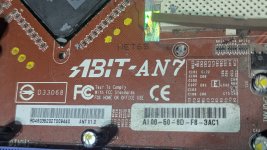
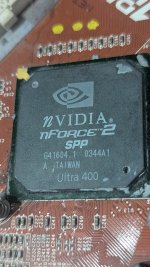


Jop. Hast du mal AIDA mit beiden gebencht? Ich habe bei mir das Gefühl, dass ich nicht unter eine bestimmte Latenz (~62ns) komme. Egal wie ich es drehe, der Chipsatz rennt gegen eine (Latenz) Wand. Also schärfere Timings, bissel mehr Takt…Mir war ehrlich gesagt nicht klar wie die tRC / tRFC Werte vom Chipsatz, Multi und Takt abhängen.
Same. I started overclocking as a kid on this platform in 2004 and basically never stopped. I still own my first Athlon XP 2700+ and even the XP-m 0352 MPMW I bought 20 years ago. Same for the water cooling and a lot of parts. Now, 20 years later I’m still in my 30ties and still enjoying it. Only difference is that I learned to properly solder and bios hacking in the past 6 years.It’s been many years since I’ve worked with Socket 462, but if I can restore some of my motherboards, I’d like to experiment with the limits 😃
I enjoy being here with your knowledge, it motivates me and others to relive that great era of the AthlonXP 😍
This cpu seems just as good as my best xp-m. Great find.Testing at 1.825v (never tested at 1.800v) for PI32M stabilty.
I did not see any gain past 1.9V on mine but from what I’ve seen this seems to be very much depend on the individual board.Do you know how much Vdd the chipset can handle?
If there’s actually some gain, I’d like to apply a bit of cooling (around 0° to 10°), to avoid condensation issues.
Leute, habe ich Sachen gesehen
AIDA habe ich nicht nachgesehen. Ich gehe auch davon aus, dass der Chipsatz oder CPU in ein Limit läuft. So oder so, ich habe beim ersten ASUS noch ein paar Hausaufgaben. Es läuft mit 3,25V beim RAM sehr gut, macht bei 3,4V aber seine Problemchen. Ich habe noch versucht an Sandmans Takt zu kommen, habe ich aber nicht geschafft. Ich werde das board erst einmal zur Seite legen und mit dem anderen gemoddeten ASUS und einer anderen CPU neu versuchen.Jop. Hast du mal AIDA mit beiden gebencht? Ich habe bei mir das Gefühl, dass ich nicht unter eine bestimmte Latenz (~62ns) komme. Egal wie ich es drehe, der Chipsatz rennt gegen eine (Latenz) Wand. Also schärfere Timings, bissel mehr Takt…
Die ASUS boards sind so ziemliche Bastelbuden bei mir. Damit habe ich das modden, recappen und co angefangen und daran geübt. Die ASUS boards stecken eine Menge weg. Ich sehe bisher auch keine Degradierung.Ist auf dem Asus irgendwas an der Vdimm umgebastelt? Also niederohmiger Feedback rework, R308 oder so? Vielleicht liegt da der Hund begraben…
 Ich habe ein paar Fotos gemacht.
R313 = 2720 Ohm = 2,64v | 272 | 43B |
R314 = 1200 Ohm = 2,85V | 122 | 09B |
R315 = 3300 Ohm = 3,30V | 332 | 51B |
R316 = 10 kOhm = 3,53V | 103 | 01C |Ich denke die RAM Spannung beim ASUS ist ansich nicht so schlecht. Es braucht die richtigen mods.Mittlerweile überlege ich auch, ob es eventuell leichter ist Chipsatz und RAM einfach über ePower zu betreiben. Der CM3708 schafft laut Datenblatt 3A Dauer und 6A Peak, was bei 1.9V “nur” 6W Dauer sind. Immerhin schaltet er mit 600kHz. Für NB und SB finde ich das arg wenig.
R313 = 2720 Ohm = 2,64v  | 272 | 43B |
R314 = 1200 Ohm = 2,85V  | 122 | 09B |
R315 = 3300 Ohm = 3,30V  | 332 | 51B |
R316 = 10 kOhm  = 3,53V  | 103 | 01C |
--------------------------------------
R313 = 1000 Ohm = 2,53v | 102 | 01B |
R314 = 470 Ohm = 2,9V | 471 | 66A |
R315 = 1100 Ohm = 3,26V | 112 | 05B |
R316 = 2100 Ohm = 3,65V | 212 | 32B |
--------------------------------------
R313 = 1500 Ohm = 2,52v | 152 | 18B |
R314 = 700 Ohm = 2,88V | 701 | 82A |
R315 = 1700 Ohm = 3,23V | 172 | 23B |
R316 = 3500 Ohm = 3,60V | 352 | 53B |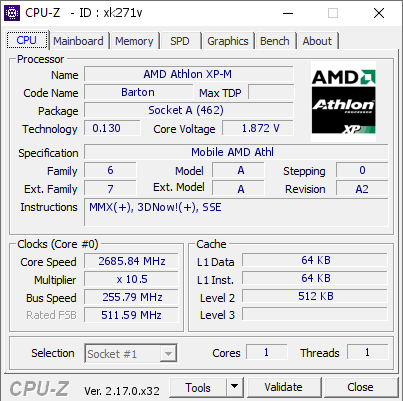
 valid.x86.fr
 valid.x86.fr
>2700-MHz
Anhang anzeigen 1196144
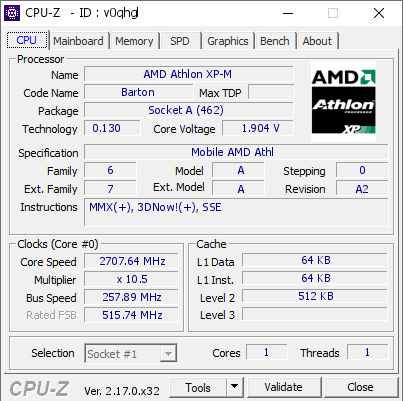
AMD Athlon XP-M @ 2707.64 MHz - CPU-Z VALIDATOR
[v0qhgl] Validated Dump by Sandman HWL (2026-04-02 07:30:51) - MB: Unknown nVidia-nForce - RAM: 512 MB
Infras tight BH5 Timings, 3.3V VDimm. Chipsatz ist ein Glücksspiel. Kann auch mit 1.7V laufen.
Was ist das bitte? https://hwbot.org/benchmarks/superpi_-_1m/submissions/935288
Axo... https://community.hwbot.org/topic/189278-sold-rare-dfi-lanparty-nf2-rev-a-amd-athlon’s-kingston-khx3200k2512-kit/
Mod your Infinity to the max




 valid.x86.fr
That’ll take some time, but these are indeed (very) good hands. You won’t regret sending him that huge box.My idea is to bring my nForce2 collection back to life hopefully by replacing the capacitors they’ll work again (with a modVolt.) 🤞
I’m leaving this work in good hands @digitalbath , who will soon receive a package of 20 motherboards 😇

Kommando zurück. Es lag an "drive strength". Ich habe das runter auf 1 gesetzt. Dann läuft es. Ab 260MHz geht der NF2 Chipsatz aber bergab mit den straffen timings. Das Ergebnis ging grade so durch. Das Board schafft ein paar MHz mehr, dann aber brauche ich vermutlich mehr Spannung am RAM und schlechtere tRC, TRFC und alpha timings. Hier aktuell mit 3,45V.AIDA habe ich nicht nachgesehen. Ich gehe auch davon aus, dass der Chipsatz oder CPU in ein Limit läuft. So oder so, ich habe beim ersten ASUS noch ein paar Hausaufgaben. Es läuft mit 3,25V beim RAM sehr gut, macht bei 3,4V aber seine Problemchen. Ich habe noch versucht an Sandmans Takt zu kommen, habe ich aber nicht geschafft. Ich werde das board erst einmal zur Seite legen und mit dem anderen gemoddeten ASUS und einer anderen CPU neu versuchen.