@RedF @ApolloX @Tatilica
Lange Nacht geworden gestern, wie das ja immer so ist.
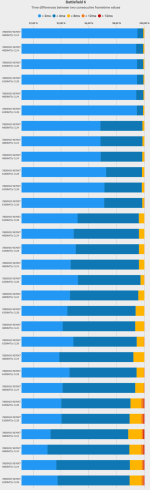
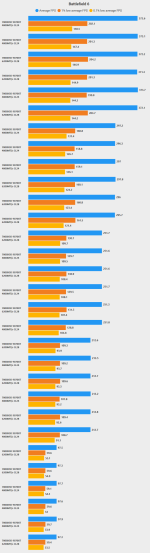
Battlefield 6 Benchmark ist durch in der Mission No Sleep (da hat auch PCGH den CPU Test gemacht). Start über Leertaste, was Aufzeichnung und Mission immer exakt identisch startet. 2s Verweilzeit bis die Aufzeichnung beginnt und dann 100s Laufzeit. Immer 6 Ergebnisse für eine Einstellung, 3 je RAM Einstellung; in Reihenfolge: SD Niedrige, SD Hoch, SD Ultra, SD Hemmungslos, UWQHD Hemmungslos.
Kein Upscaling, kein Frame Generation, TAA an. 7800X3D -20mV all Core, +200mhz, 9070XT 374w, -100mV, 2860mhz VRAM. Windows 10, Treiber 25.9.1.
Ich sehe da keinen vernünftigen Unterschied in der RAM Geschwindigkeit, zumal die Haupttimings bei 4800MT/s schlechter sind als bei 6200MT/s.
Bestätigt mir selbst nochmal, das die RAM Geschwindigkeit bei meinem 7800X3D egal ist. Wie auch immer man auf die Unterschiede beim 5800X3D und 9800X3D kommt, ich komme da beim 7800X3D nicht drauf.
It got late again last night, as it always does.
The Battlefield 6 benchmark is complete in the “No Sleep” mission (this is also where PCGH ran their CPU test). The run is started via the space bar, ensuring that the recording and the mission always start in exactly the same way. There is a 2-second delay before the recording begins, followed by a 100-second runtime. There are always 6 results per setting, 3 per RAM configuration; in order: SD Low, SD High, SD Ultra, SD Unrestricted, UWQHD Unrestricted.
No upscaling, no frame generation, TAA enabled. 7800X3D -20mV all Core, +200mhz, 9070XT at 374 W, −100 mV, 2860 MHz VRAM. Windows 10, driver 25.9.1.
I don’t see any meaningful difference in RAM speed here, especially since the primary timings at 4800 MT/s are worse than at 6200 MT/s.
I’m essentially confirming for myself once again that RAM speed doesn’t matter for my 7800X3D. However people are finding differences with the 5800X3D and 9800X3D, I can’t see or reproduce them on the 7800X3D.